Sunday, November 7, 2010

Elder Christofferson Visits; More Projects!

Dear Family and Friends:

It is a busy and interesting time here in Zimbabwe.  We had a Priesthood Leadership Training session on Oct. 23 and two stake conferences on Sunday, Oct. 24th.  We were excited to have Elder D. Todd Christofferson from the Quorum of the Twelve Apostles, Elder Steven E. Snow from presidency of the Seventy, and Elder Koelliker, the area president for South East Africa area of the Church, come and speak to us.  While the men were holding the Priesthood Leadership Training, we took their wives to visit some of our humanitarian projects.  We had typed up nice handouts for this project tour and hoped they would ask a lot of questions. Sister Christofferson and Sister Snow rode with us in our truck, and Sister Koelliker rode with Sister Dube, the mission president’s wife.

Newborn at the Clinic
Visiting the Clinic
We selected three projects.  One is the Henry John Reimer Clinic.  The Church installed two transformers and a water pump in this clinic.  Prior to LDS Charities help, they had gone five years without water in the clinic and staff living quarters, three years without electricity in the staff  living quarters and two years without electricity in the clinic.  This clinic serves 500 plus patients monthly, including maternity and children services.  It is difficult to deliver babies by candlelight.  We visited this clinic to inform them we would be bringing visitors on Saturday and a baby was born while we were there.  It was so very new and so cute and I took a picture of the mom and baby The mom asked if I would bring her a copy of the picture when we come back. Most people here have never had a picture of their kids or themselves and they love it when I take their picture and show it to them.  They laugh and look again and again in complete wonderment.  We were hoping another baby would be born during our visit with Sister’s Christofferson, Snow and Koelliker, but this didn’t happen. Very few women give birth at a clinic; they mostly deliver at home in their village in not the best of circumstances.  This woman was very lucky that a clinic was close by and it had electricity and a clean delivery room. The sisters were very interested and asked a lot of questions.

Visiting the Kowoyo Clinic
Next we took them to the Kowoyo Clinic where the Church installed a transformer and rehabilitated the borehole with a new motor and booster pump and elevated a new 5,000 liter water tank.  This clinic serves 400 – 500 patients monthly and there are always many people, including children, lined up outside the clinic waiting for help. We all sat outside and all the sisters asked a lot of questions.  Sister Christofferson, Snow and Koelliker were all so much fun and very wonderful with the women at the clinic. 

Elder Bean and Sis. Christofferson tasting cornmeal flour
The last place we visited was the  Kadyamare Primary School where the Church provided a dehuller and grinding mill and installed cable to the mill for electricity.  This project benefits the community and the school. The people in the community take their maize to the mill for grinding into flour and pay $1.00 a bucket for this service. The proceeds from the grinding mill in turn help fund books, food, school fees, uniforms, etc. for the school kids. It was fun to watch Sister Christofferson put some of the maize flour in her hand and taste it.  We also arranged for the kids to do some African dancing for the sisters and they loved it.  We enjoyed telling the sisters about the Church’s humanitarian projects and how they benefit so many people, and how we expect the beneficiaries to help by contributing work, time and effort in return.
African Dancers

We returned at noon and they joined their husbands for lunch.  In the afternoon all the missionaries attended a special meeting  It was wonderful to hear an apostle speak about missionary work and especially about missionary work in our area.  The young missionaries were so excited, and it was great to look over the audience and see these special young men and women so quiet and so in awe to see an apostle personally.  After he spoke, he left time for them to ask questions.  At first they were shy, but soon they were really getting into it.   Sunday was the Mission Conference and Elder and Sister Christofferson spoke, along with Elder and Sister Koelliker.  The conference was held in a large beautiful building that looked somewhat like an opera house, with a balcony and a loge and the chairs in front covered with white material and tied in the back. We really enjoyed the conference. We were so happy to see seven of the young missionaries we served with in Uganda there and had a good time renewing our relationships.  They were sent from Zimbabwe to Uganda and had returned home to Zimbabwe.  The senior missionaries and the special guests then left for a dinner at the Mission home.

Beans and Christoffersons

Beans and Huskinsons
Ron and Jenny Huskinson were visiting with us from Idaho, and attended the conference also. We served with them in Uganda and we were so pleased when they said they would come and visit us in Zimbabwe.  We asked President Dube’s permission to have them included in the dinner on Sunday afternoon at the mission home, so it was fun to have lunch with Elders Christofferson, Snow, Koelliker, their wives and our friends.

 We left with the Huskinson’s on Monday to visit Victoria Falls, Botswana and Hwange National Park.
On Safari
We met a wonderful young LDS women in our office a few weeks ago who is a tour director in Botswana and arranges safaris.  Her family had lost their farm in Zimbabwe during the farm invasions and had fled to Botswana for safety and a new life. She said she would arrange and accompany us on a safari in the Chobe National Park in Botswana, so we parked our truck on the Zimbabwe side and walked across the border to Botswana, where she met us. In the morning we cruised the Chobe River, on one side of the River was Botswana and on the other side was the country of Zambia,  we had a nice lunch and then rode in one of those cool safari vehicles.  We saw elephants, hippos, crocs, beautiful exotic birds, etc.  .She really made this a wonderful adventure for us.


Victoria Falls


The next day we visited Victoria Falls in Zimbabwe, which is very impressive. I believe they are larger than Niagara Falls, at least cover a wider/longer distance. .We also had arranged for a sunset cruise on the Zambezi River, which is the boundary between Botswana, Zambia and Zimbabwe.  On the way back to Harare, we stayed at the Safari Lodge in the Hwange National Game Park in Zimbabwe and were lucky enough to see about 300 plus elephants at a waterhole.  The guides stopped in the middle of them we were surrounded by elephants.  I especially loved the moms and baby elephants. We then returned to Harare, took the Huskinson’s to the airport, and now are back to work in our office.We just received word that our next big water project, in an area called Goromonzi, has been approved, so it was nice to have a fun outing before we start again on another big water project.  They are very time consuming and involve many late nights and a lot of driving.  We work on smaller projects along with the water.  This is a great mission, a little free time and a lot of work and responsibility after, and also a great deal of paperwork.


Two weeks ago, we drove to Bulawayo, where we checked out prospective water project, as well as meeting with several NGO’s to discuss some smaller projects. We were called on the phone by the Stake Presidency in that area and they told us that there is a critical water shortage in that city. We visited there for four days and met with the Bulawayo City Council and promised them 12 boreholes, which we will be doing immediately. We will not have to wait long for approval as we received a phone call from South Africa that they wanted this one done asap.  Both of the dams have dried out, a lot of the boreholes have gone dry and there is very little water to be had in the whole city.  The power was out for most of our stay and it is very strange to see a big city without power in any of the stores, buildings, or anything else.  We stayed at The Holiday Inn, which also did not have electricity.

LDS Charities' Hired Driver
Bulawayo is the second largest city in Zimbabwe and is the headquarters for the opposition party (the party not in power) so again we have to stay out of their politics and just do what we are there to do.  Zimbabwe is still a very politically sensitive country and it has only been a year or two since terrible things have happened to this country and to its people.  Just a few years ago there was nothing on any of the shelves to buy, no food or any goods whatsoever.  There was nothing to eat and people had to flee to Botswana, Zambia or South Africa for food and safety.  Goods are appearing back on the shelves now and we have no problems buying food   The American dollar is now being used instead of the Zim and the economy is starting to level off.  We must be careful not to wave with an open hand, because that is the opposition party’s symbol.  Out yellow Helping Hand T shirts cannot be worn here, as they have an open hand on them.  The word “Change” cannot be used when we discuss our water projects or anything else, because that also is the opposition party’s slogan.  Just some things to be aware of when traveling around this country.  There are still a police present on most of the roads and they either will wave you by or stop you to look things over.  They seem friendly enough. The things we have going for us are our missionary badges and the logo on the door of our car, which says: “Latter-day Saint Charities”. That is how we are identified in this country, not by the Church’s name, but by Latter-day Saint Charities.

"My kind of town, Chicago is . . . ."
We also visited with a NGO who is helping child heads of households.  These are children from 12 to 14 years of age who have lost both parents due to AIDS and are now raising their younger siblings. They are just kids themselves and some are trying to care for 3 or 4 younger siblings by themselves. This organization is trying to keep them in school, while helping with food shelter, health issues, etc. and is trying to teach them skills to prepare them for future employment.  The woman who heads this organization is wonderful.  She is 29 years old, very educated, lived in Chicago for a number of years working with street kids and has now returned to Zimbabwe, where she was born, to help the young people here. When we met with the kids and talked with them they were all wearing T-shirts that had CHICAGO stamped on the front.  When they greeted us, Elder Bean did a very funny dance while he sang “Chicago” to them.  They responded by doing an African dance for us.  It was very funny.

Bee Keeping Beauties
She has two other women helping with this organization.  We met with them and reviewed their proposal.  They want the kids to learn a bee keeping vocation.  When Zimbabwe was in the midst of farm invasions, all the bee keepers who were located on or near farms fled for safety and so were put out of business.  At that time there was a strong bee keeper organization with many members, but they all left the country during this period.  There are only two left in the whole country and they are lending their expertise to this project.  They are holding classes and educating the kids in bee keeping.   We were shown a beehive that was donated to the organization and they will use it as a pattern.  We were asked to supply lumber, wire, nails, etc. to make many more. They have a local man who does carpentry and will pay him a small fee for constructing the hives.   We were also asked to provide gloves, clothing and other items for protection. One of the mothers of a lady involved in the organization wove straw hats to protect their heads and they will sew net around the hat to protect their faces.  I was given a hat as a gift and it is beautifully made.  There is a picture in this blog of the beehive and the straw hats.  Their goal is to start a business selling honey, using the wax to make candles and eventually want to grow lavender plants in their gardens to attract the bees, which would allow them to sell lavender hone and perhaps lotions, lavender tea, etc.  The kids will then be able to support themselves and as the business grows, more kids can get involved.  We liked the project and the kids and we are putting a project together to help them with many of the things they need to get started.  We love this kind of project, where the beneficiaries are involved in the work and the project is sustainable and should go on for many years and it helps a large number of people.

When we were through meeting with all the relevant people, we took a drive to a national park called Matobos.  It was like something from another planet. We paid a fee to get into the park, which also includes a huge game preserve.  It was really wonderful.  At one time it was home to a very ancient people.  Some of the formations looked like huge castles and some like animals, there were caves, which had ancient native drawings of leopards, giraffes, etc.  It is also the grave of Cecil J.  Rhodes, who the country of Rhodesia was named after and who started the Rhodes scholarship awards.   We drove for many miles on a dirt road and then much to our amazement there appeared a beautiful lodge with separate guest rooms shaped like African huts, a swimming pool, a separate dining area and a view of gorgeous rock formations in this very deserted place.  We would like to go back and visit the game park someday and spend the night in the lodge. .

Matabos National Park

Another side of this country that is not so nice is the blatant bribery system. We were pulled over by the police last week for running a red light (robot).  Elder Bean told the policeman that he did not run a red light it was green.  The policemen said “What color was the robot”?  Elder Bean said “green”.  The policeman said no it was red.  Elder Bean said it was green and was getting agitated and the policeman could see he was making him mad and so he became belligerent and a little nasty and said he would give us a ticket for running a red robot and we would have to go to court on Wednesday.  I said that we could not go to court on Wednesday because we were going out of town to help his country with its water problem.  I thought that might help our cause and asked if we could pay the ticket here. He acted shocked and said – it was a serious matter to run a red robot, anything else we could have made arrangements with him, but not this terrible thing we had done.  By this time I was poking Elder Bean to settle down or we would be taken to jail.  I asked again if we couldn’t work something out right now and he asked how much do you have. Elder Bean - said $10.00 – the policeman told us that we had done was very serious and $10.00 was too little to pay for such a terrible and serious infraction.  He said the ticket would cost us $20.00.  We agreed. He came around to my side of the truck and I rolled my window down and he told me to fold the money up very small and carefully hand it to him quickly out of the window.  I asked if he would void the ticket and he did.  It makes you so mad to be taken advantage of like that, but we are powerless, they can take you to jail and cause you a whole lot of trouble. We did not run a red robot, but he saw we were white and that means we have money and figured he would get some of it, and he did.  All of us on this mission have similar stories. 

It is a beautiful time of year – Zimbabwe has thousands of Jacaranda trees and they are all in bloom.,  The streets in the city and everywhere else we have been, even in the rurals, are framed with these beautiful purple trees – they form an arch on both sides of the street in some places and we drive under them.  They are gorgeous – the purple shade is like a color you cannot even describe.  They are everywhere.  I have taken many pictures and just can’t seem to take enough pictures of them.  I keep asking Elder Bean to stop, so I can get another picture.  Every bush and tree it seems is covered with blossoms of one color or another and we are told the next tree to bloom is called Flamboyant and they are a bright orange and more beautiful than the Jacaranda, I can’t believe it.    Out in the rurals, the fields are very dry.  They have not had rain since last January and so you wonder why the trees and bushes are still alive. 

Jacaranda Tree
We are busy, but miss family and friends.  Please remember us in your prayers. 

Elder and Sister Bean

PS.  I know you are thinking we are having too much fun, and we are.

Sunday, October 10, 2010

Water Project Approved and Chapel Fire

Looking for Frangos
Dear Family and Friends

Last week we went to Chegutu, a small village south of Harare, to participate in a handover of school supplies for 400 students ranging in age from primary to grade 8.  The Church had provided them with a grinding mill for grinding maize into flour and so far they have earned $700.00, which is a considerable amount of money for them.  With this money they bought school supplies for the children in the nearby school.  They asked us to come and help them pass out the supplies.  It was so much fun.  

Delivering School Tablets
When we arrived they greeted us with African dancing, singing and drumming  The kids were all sitting either on the ground or behind  small tables outside.  It is always very colorful, cattle wandering by, chickens walking around, mud huts in the background. plus a beautiful bright pink blossomed tree adding to the picture...We spoke for a few minutes, enjoyed some more dancing and then the kids lined up to receive their school supplies.  The young ones received one pencil and four small writing tablets.  The older ones received one pen and four writing tablets.  This was really exciting for them. It is still a cause of wonderment to us on how relatively small things mean so much to the children here.  We hand out sweets that we carry in our car or balloons along the way and the children love it.

We then checked out the grinding mill and when we got back to Harare we bought some ear plugs and a mouth and nose shield for the miller.  The sound of a motor and maize being ground was very loud in the mill, and we are sure the miller will be deaf within a month, and breathing in the maize chaff and dust was also a health concern.  It was a fun and rewarding day.  The African people are such great hosts and always provide us with a drink or a biscuit or something to eat where ever we go.  We then met with the headmaster and school teachers and looked at their accounting books to see how they are keeping track of their money and expenses from the mill.  Elder Bean gave them some good advice on how to account for the money received and how to figure their expenses and what to charge per bucket of maize. They are charging 50 cents a bucket and he thinks they should charge a dollar.  If the people cannot pay in money, then the mill should take a portion of their maize to sell.  This money will then can go to feed the kids. They listened very intently and really appreciated the help and asked many questions on running a business. It is always fun to actually hand over the merchandise that has been purchased with the proceeds from a fairly successful project.

We had a few problems getting the final approval from South Africa for the water project in Muzarabani.  But HOORAY! We finally received approval on Friday, Sept. 10, 2010.  We have most everything in place ready to go, just waiting for the go ahead.  We wanted to get started before the rainy season sets in.  This is an area that has major flooding problems when the rain comes the roads and areas where the boreholes will be drilled, would be made impossible to get the drilling rig in.  It would also make the hygiene and sanitation training impossible, because the training is done outside under trees. We also have arranged to provide, with the villagers help, two latrines per borehole.  We just want to get started and beat the rain.

Children at Water Project Site

Friday, September 24, 2010

First Water Project and Beads!!!!!


Note:  The Blogmaster received this e-mail and pictures a couple of weeks ago, but I am only posting it today due to the technical difficulties.  Look for a follow up blog soon!

Dear Family and Friends:
We are so excited, it took a lot of planning, organization and thought and talking to many people, but we just sent our first large water project to South Africa for approval, This project is located in the northeast district of Zimbabwe where we will drill 24 boreholes, construct 48 latrines and train 2,400 families in sanitation and hygiene and reward them with mosquito nets, hygiene kits, and washing soap for attending the classes. We will hire a water monitor, a sanitation supervisor, and three trainers to train 48 volunteer trainers from the villages for this project.  It will really financially benefit those we hire and help them in future employment opportunities.  We have a wonderful group of people to work with. To show how much the Church is willing to spend to on water and sanitation, we have budgeted about $229, 175 for this one project.
Last week we visited the Goromonzi District, with a man called Pastor Wonder, to assess the water needs of 30 villages in that area. This district is about 20 miles north of Harare. The Pastor had visited us earlier in our office and asked us to accompany him to visit this area. He said they desperately needed clean water, latrines and sanitation/hygiene training. This is another extensive project involving many villages and many people this will be our second water project if we decide to do it. We met with four different groups representing about thirty villages. 
Tafirenyika Villagers
The first village we visited is called Tafirenyika.  The people are so very poor and there is a lot of sickness in this area. There are approximately 1,500 people in this village.  About 400 of them were waiting for us to come and talk with them.  They were sitting in the dirt under a tree; men sitting on one side and women and children on the other.  Men and women do not sit together, even at Church, and that is something the Church is trying to change. We had brought an interpreter, but they also supplied one of their own.

They opened the meeting with prayer and then introduced us in Shona (the local language) and then again in English.  I spoke for a few minutes and then Elder Bean explained the project and the training sessions.  He also explained the incentives offered to attend the hygiene training.  If their representatives would come to all or most of the training sessions, they would receive hygiene kits, and soap, as well as a special certificate of completion with their name of it. The plan is to train a few people from their village and then they will go back to their villages and train the people in what they have learned. The villagers liked the plan and clapped their approval. We are always a little worried, about what is being said, since we don’t speak the language, and their interpreter is promising them more than we are willing to provide.

We then left to meet with the next village – where we explained the project again  We are also asking each village to organize a committee that will take charge and maintain the boreholes, plus build the latrines or “squat holes” as they are called here.  We provide the cement and wire for the latrines and they supply the labor and some sort of a structure.

As we traveled to the next village, we saw women and children washing clothes in the small rivers/streams along the way.  These are the same small streams where they get their drinking water and their animals come to drink and do other things.  This is the dry season so the water is very scarce and only small streams exist. These are also areas that just a few months ago were hit hard with an epidemic of cholera and diarrhea.  It is a prime area to start helping with some water projects and sanitation training.  We also intend to monitor how many illnesses and deaths occurred before we drilled boreholes and started the water and sanitation project and if there is less sickness and deaths after the project is put in place. The roads were terrible and you have to be careful not to hit your head on the roof of the car, because some of the pot holes are so deep. 

After we visited all of the villages, we were told we should, as a courtesy, pay a visit to the “Headman” or chief in that area.  He is not a political leader and does not really have any power or authority, but is a traditional chief, over all the people in this area, and it is a sign of respect to ask his permission to work in his area.  This is part of the culture of the old ways. We drove to his hut and it was a very interesting experience.  He was not in attendance, but his number one wife was in the hut cooking sudza which is flour and maize boiled like porridge and is the staple food in Zimbabwe.  This headman is a polygamist and has two or three other wives, and many many children. The hut we were ushered into was the typical cone shaped hut with a thatched roof.  It had an opening in the roof for the smoke to go out.  The hut was very smoky as the No. one wife had a large fire built in the middle of the hut and was stirring the sudza with a wooden spoon.  She was traditionally built, had bare feet and just a few teeth.  She was sitting on the floor, and was very friendly and offered us a dish of sudza.  We declined very respectfully. There were various pans and containers setting around and a few wooden benches to sit on, actually the hut was larger inside than I expected, but so filled with smoke that I kept coughing and wiping my eyes.  There was another hut close by for the second wife – interesting.  We still will have to go back and inform him of our plans and receive his blessing to work in his area. 

We then visited the head of the government water district whose permission really matters.  He was delighted to have us provide water in his area and even offered to have some of his people assist us, which we are happy to have their support.  There are many layers of political people that have to be consulted before starting any projects. 

Friday evening we met with the stake presidents, counselors, and mission president for the Zimbabwe Coordinating Council – three flew in from Zambia to attend.  I think they also wanted to meet us and also find out what projects we might be doing in their areas.  That is why we were invited.  . We spoke about some of the projects we had done in Uganda and then talked about projects we have already sent in and are awaiting approval. We answered some questions and then we were dismissed to go home. 

The presidents from Zambia were particularly interested. In what projects they wanted us to do.  We will be going shortly to their area to do some investigative work.  They will be invaluable to us.  The area president from South Africa conducted the meeting.  His name is Elder Colin H. Bricknell. 

We were also informed that there will be a Priesthood Leadership Conference with Elder Christofferson of the Quorum of the Twelve and Elder Steven E. Snow of the Presidency of the Seventy on October 22 thru the 24th. They will also be accompanied by Elder Paul H Koelliker of the Seventy held in Harare, Zimbabwe.  We are all very excited. The senior couples are invited to meet with them and their wives at a special dinner at the mission home on the 22nd.  .  While the men are in their priesthood meeting on Saturday, the mission president’s wife will take the wives to visit craft markets.  That will be a lot of fun.
Joseph Smith?
Sunday – August 29, 2010 – Drove to Kadoma for church at our branch – it is about a 2 hour drive.  It was a beautiful drive. We attended church and only had one person ask us for assistance. This is very unusual because usually there are quite a few that ask.  It is always difficult to refuse, as everyone needs help.  The Church is well organized there and all the meetings were excellent. They do a very unique thing.  In between Sacrament and Gospel Doctrine classes, they take a break and everyone goes outside to visit and stretch their legs for about 10 minutes, then a cowbell is rung many times and that means to go to class.  When class is finished the cowbell is rung again and people go outside for a small break, then the cowbell is rung again and we all go back for Relief Society and Priesthood, then they ring it again, which means class is over.  It actually is quite funny and we liked it. On the way back we took a picture of a small hut along the roadside with sacks of oranges hanging outside and a woman with a baby on her back selling them.  When we arrived home we had power, which is so nice and appreciated.

These entrepreneurs had a VERY good day.
Yesterday we visited our assigned second branch. This is the branch that takes four plus hours to drive to.  We always go on Saturday, spend the night and then go to Church at 9:00 the next morning.  When we arrived on Saturday afternoon, we asked the people at the Inn if there was something interesting we could do for the afternoon.  They suggested we drive to the Lake in the area and cross the dam and see the black rock cliffs on the other side.  We drove to the dam and had to stop before crossing because there is only one narrow lane across this very high dam and two cars cannot cross at the same time.  It is a perfect spot for little local kids to storm your truck and try to sell you necklaces and baskets.  So while we waited to cross the dam, about 7 or 8 young boys with necklaces and baskets threaded all up their arms ran to our truck to try and sell us something.  I said to Elder Bean, we should buy a few necklaces from them and help them out.  I rolled the window down, which was a mistake, and about 8 to ten little black arms thrust themselves into my open window.  They were dropping necklaces inside our truck, in my lap and everywhere. in their frenzy to get me to buy from them.  I kept saying wait, wait I can’t even see them.  How much? They said $2.00 each and were fighting each other to make a sale.  I only had four one dollar bills and so I said I will take two. I hardly knew who I gave the money to.  I finally had to roll up the window and it was our turn to cross the dam. 

On the other side we parked and hiked down the overlook to see the Lake, two of the young boys had followed us across the dam and were standing on the rocks waiting for us with necklaces to sell.  We actually thought it was pretty cute that they were such little relentless salesmen.  I told them I did not have any more dollar bills.  I asked Elder Bean to check his wallet again and the boys saw a ten dollar bill in his wallet.  They talked among themselves in Shona, and then came up with the plan that they would sell us 10 necklaces for $10.00.  How could we refuse?  We told them they had a deal, gave them $10.00 and they threw in an extra necklace and a pick for my hair.  We then invited them to come to our truck and gave them some sweets (candy).  We were impressed, what little smart business men.  The necklaces are made of local seeds that they gather and string, but pretty cute.  It was at the end of the day and they had sold all their necklaces for the day, I think to us. They then said, thank you now we have money so we can eat, that made us feel very sad.

We feel so sorry that we could not attend Torri and Rex’s wedding day last Saturday.  I felt sad all day on Saturday.  The sad thing about being so far away is that you miss wonderful important things that happen back home and wonderful family events. . We are so proud of them and so happy for them and we would love to have been at their ceremony in the Seattle temple.  The whole family on both sides attended the temple as well as a very nice luncheon at the Palisades restaurant in Seattle after the ceremony.  We love them both very much and if thoughts could be conveyed from so far away, they knew that we were thinking of them all day on Saturday.  We are anxiously awaiting pictures and information.

Thanks for your prayers on our behalf.  Love to all of you.  Elder and Sister Bean. 

PS.  I am typing this blog in our office and the biggest spider I have ever seen came walking down the hall.  It is huge and very tall with very long legs.   Elder Bean sprayed bug spray on it and it didn’t even phase it.  It just keeps coming.  I was ready to stand on a desk.  Finally, he swept it outside.  This is the first one I have seen since being here.  Yuk!!!!

Tuesday, August 24, 2010

The Great Zimbabwe, Church and Projects


(Written by Sister Bean with Elder Bean’s input)

Dear Family and Friends:

We have had an interesting two weeks in Zimbabwe. We are responsible for two branches of the Church; one is located approximately two hours away in a town called Kadoma, which is a little south west of Harare. The church building is very nice and looks like a regular LDS church. There were 121 in attendance and the meeting was well organized. Last Saturday we left Harare to attend the Masvingo branch, which is our second branch to visit. It is located approximately four hours away. We had to leave on Saturday in order to be there at 9:00 am on Sunday, since we do not want to drive at night. We arrived in the town of Masvingo early afternoon Saturday and went on a tour of a very interesting world historical site called “The Great Zimbabwe.”

This is the site of some very ancient ruins thought to be at least 800 years old or older. It is the site of an ancient civilization that appears to be fairly sophisticated. The country of Zimbabwe received its name from this site. In 1980 when Rhodesia gained its independence from Britain, the country was then renamed Zimbabwe, which name was taken from this ancient site. The symbol of the bird on the Zimbabwean flag was also taken from an ancient soapstone carving found in these ruins.

Elder Bean checks out the Flora
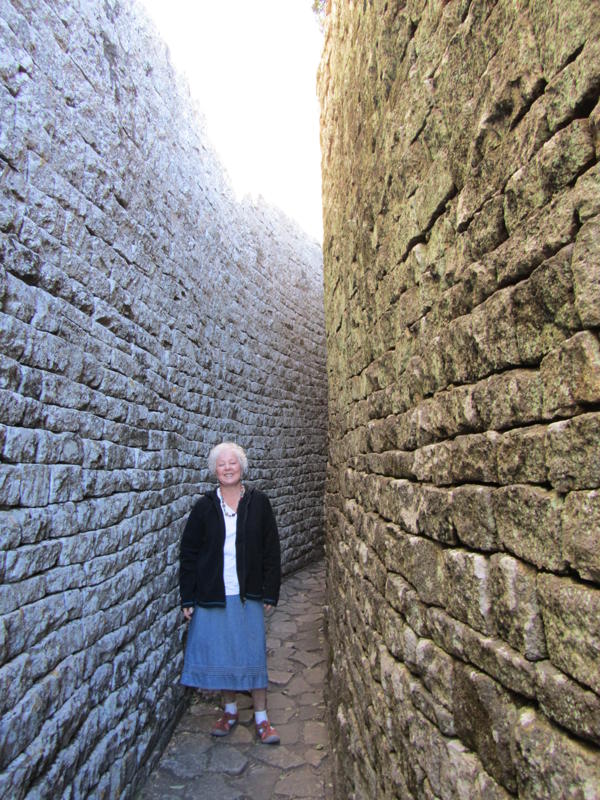
We hired a guide and she took just the two of us on the tour. It was fascinating. We climbed on ancient flat topped stone steps laid in regular patterns that wound up to the top of a very very very high structure built on the top of a cliff. The walls of this ancient structure were stones placed one on top of each other in a very systematic order without the use of mortar. We can’t imagine how they have withstood the test of time without toppling over. We climbed what seemed to be forever, sometimes through very narrow passages that only one person could barely get through. I was worried about climbing down after reaching the top, as the steps were very hard to stand on and very uneven and some loose and broken. The guide said not to worry that she would take us down the “modern steps” on the other side, which were very easy. On climbing down I asked, “When do we get to the modern steps? The guide said, “Oh, we are there”. I then asked, which I shouldn’t have, are there any snakes here? The guide said, "oh yes, the black mamba, the cobra and the python, and the python is considered sacred by our people and we do not like to kill it. They are all here."

"The Great Zimbabwe"
The site is very large and covers many hectares. We went to the huge round coliseum like structure where the king and queen lived and it was also very large, high, very thick walls and made with these same stones placed one on top of each other. The guide said this was the second largest structure in Africa, only second to the Egyptian pyramids. We really enjoyed this site and want to read more about it.

We stayed at an inn called The Inn of the Great Zimbabwe, and it was very lovely. The gardens were beautiful and it was situated above a beautiful lake. The dinner was served very elegantly and properly with waiters in uniforms, white gloves and we dined in a beautiful room. There was just one other couple and their little six year old boy staying there. The man was in charge of a big game park on the border between Zimbabwe and Mozambique and we had an interesting conversation with them. The child was delightful and very intelligent. He is being exposed to a very interesting life style. The only trouble with our stay was there was no heat or power. We went back to our very nice cold room, lit a candle and brushed our teeth in a cold bathroom and crawled into bed for warmth.

We attended the Masvingo branch the next day, which is another very nice church building. Around the exterior of the church, the members had planted a well kept vegetable garden with onions, carrots, tomatoes, etc. The interior of the church was very clean and the branch president is a very intelligent, impressive man. The congregation was singing as we entered and it was beautiful harmony. We didn’t sing because we just wanted to listen to the beautiful music. The African’s sing the same hymns that we do, but they have a different cadence, kind of lilting –different and very beautiful. Since there was no power, everything was sung without the keyboard. We were asked to speak and share our testimonies. The branch president taught Relief Society and the lesson was about the organization of the priesthood. He did a wonderful job. The members were very friendly and loving and wanted their pictures taken with us before we left. We really enjoyed it. We of course were the only white couple in church, but felt very comfortable. This is the area where they make the beautiful baskets and we want to buy a few the next time we visit the Church.

It took a long time to drive back to Harare, with a lot of big trucks on the road transporting fuel and goods from Johannesburg, which made driving slow and passing tough. There were several toll stations along the way and many policemen standing along the road. They may motion you to pull over, which might be a problem or might not. They waved us through.

The country side is very dry, since the rains don’t come until November. There are hundreds and hundreds of acres of empty fields full of tall yellow grass; some have been burned to keep the grass down. These are the sites where the Dutch farmers once had their farms. There are acacias trees dotted here and there or in groups all over the fields. These are the trees that we always associate with the landscape of Africa, trees that you see in books and movies about Africa. We are sure that at one time long ago these fields and savannahs were filled with elephants, giraffes, etc. The wind blows a lot and so far it has been very sunny, but cool. I am very grateful that a coat was left behind for me by the departing senior couple.

A latrine? Or someone's house?
We are scheduled all this week and next to look for sites to drill for boreholes or bush pumps as they are called here and build latrines, so we will be spending much of our time in the truck. I made a terrible foot-in-the mouth comment a few days ago when we visited a village up north to check out existing sites of latrines and boreholes and where new ones might be needed. We had two of the men from the village in our truck and they were taking us around showing us the locations. We came to a very small narrow structure made with old brick and I said “Oh is this the community latrine”? The man then said: “No this is my mother’s house”. It was terrible and I apologized over and over, while Elder Bean was almost splitting his sides trying not to laugh. Then a woman came to the car and I said to her “Oh are you his mother?” and she said, “no I am his sister”. So in just a few moments I managed to offend the whole family. You can imagine when we returned to our apartment, Elder Bean practically fell on the floor with laughter and he hasn’t let me forget it since.

We are busy and happy, but we miss all our family. We are very sad to not be there for Torri’s wedding in the Seattle Temple and the gathering of the family, but I know it will be wonderful and I will be with her in my heart and thoughts, but would rather be there in body.

New things to buy!
This is a very interesting and fascinating mission and we have met some very interesting people in our travels. We can’t wait to visit Zambia and Malawi to assess their needs and understand we might even be going to Botswana. We are still adjusting to driving, weather and culture, but feel we are really needed here. The new term we have learned here is: traffic lights are called “robots” So we should turn left at the next robot… Pretty cute I think.

Thanks to all of you for your prayers.

Love Elder and Sister Bean